Food and Farming
Grades: 6, 7, 8, 9, 10, 11, 12
Type: Lesson Plans
Subjects: Biology, Earth and Space Sciences
Authors: ClimateScience
Location: Earth
This resource has been reviewed by SubjectToClimate's climate scientists and verified for scientific accuracy and up-to-date information. Learn about our review process →
This resource has been reviewed by SubjectToClimate's climate scientists and verified for scientific accuracy and up-to-date information. Learn about our review process →
Synopsis
- This interactive course about the impacts of agriculture includes sections on food and climate, feeding 10 billion people, selective breeding, genetic engineering (GMOs), making meat, fishing and aquaculture, lab meat and plant alternatives, food waste, urban farming, and current challenges in farming.
- The course contains text, interactive questions, infographics, data charts, videos, links to references, a final quiz, and a certificate of completion.
Teaching Materials
Positives
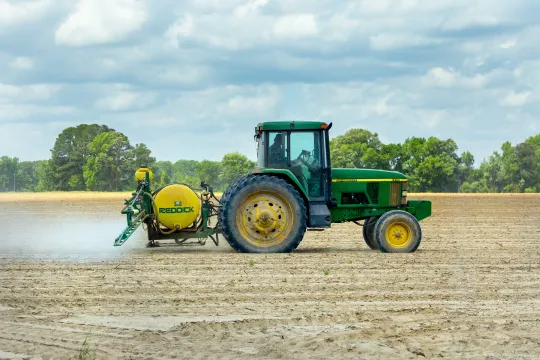
- This resource takes students through the many aspects of agriculture that affect the environment (e.g., water use, fertilizer and pesticide footprints and ecological effects, deforestation, land use changes, etc.).
- It provides ideas for sustainable agricultural solutions.
- Students earn a certificate if they complete the course.
Additional Prerequisites
- This course is part of a series of climate change courses from ClimateScience.
- Students should have a basic understanding of climate change prior to beginning this course.
- Students will need a computer and internet connection to use the interactive features and watch the videos.
- The course uses the acronym GEO instead of GMO, but they are talking about the same thing. GEO stands for genetically engineered organism and GMO stands for genetically modified organism.
- The course does not discuss the embedded pesticides in many GMO crops (Bt crops) and the much larger quantity of herbicides used on many GMO crops (made to tolerate their chemicals), which may affect water quality, biodiversity, and air quality.
- Teachers and students will need to enroll and create a free account to use the course and save their progress.
Differentiation
- This course provides two levels of learning. Before enrolling in the course, users can scroll down and use the button to toggle between. "Simple" and "Advanced." The "Simple" setting is recommended for middle school students, while the "Advanced" setting is recommended for high school students.
- Students can proceed through this course at their own pace.
- Students could research the large multinational companies that own and sell the majority of crop seeds globally.
- Cross-curricular connections could be made with geography and social studies classes when discussing the food, water, and resource needs of our growing global population.
- Students may be interested in starting a Meatless Mondays program or learning more about how to lower their own footprint by exploring these resources: Plant-Rich Diets, How to Change Your Diet to Fight Climate Change, Environmental Impacts of Food Data Explorer, and Drivers of CO2 Emissions.
The resource explores and examines the carbon footprint including anthropogenic greenhouse gases contribution from the agricultural sector globally. The datasets used are valid and accurate, and the resource is recommended for teaching.
Teaching Tips
Standards
Resource Type and Format
Scientist Reviewed
This resource has been reviewed by SubjectToClimate's climate scientists and verified for scientific accuracy and up-to-date information. Our review process ensures that every resource in our library reflects the current state of climate science.
Learn about our review process →