Urban Guide Lesson 3: What Do Urban Forests Need?
Provided by: Wisconsin Center for Environmental Education|Published on: July 10, 2026|Last updated: July 16, 2026
Grades: K, 1, 2, 3, 4
Type: Lesson Plans
Subjects: Science, Mathematics
Authors: LEAF Wisconsin K-12 Forestry Education
Location: North America > United States, North America > United States > Wisconsin

This resource has been reviewed by SubjectToClimate's climate scientists and verified for scientific accuracy and up-to-date information. Learn about our review process →
This resource has been reviewed by SubjectToClimate's climate scientists and verified for scientific accuracy and up-to-date information. Learn about our review process →
Synopsis
- This lesson explores why urban forests need management, introducing the challenges urban trees face such as soil compaction, limited space, pollution, poor soil, construction damage, invasive species, pests, disease, and storms.
- Students play a movement-based Tree's Life game in which cards representing helpful and harmful events move them forward or back, then discuss how urban and rural forest management differ.
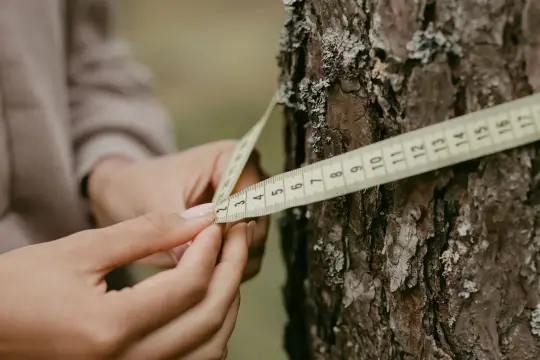
- An optional measurement activity has students use tree identification keys and diameter tapes to identify species and measure tree diameter and twig length, then graph their data to reason about forest health and diversity.
Teaching Materials
Materials:
- To engage with this lesson, teachers in Wisconsin can borrow the associated LEAF kit for all necessary materials.
- Otherwise, teachers will need:
- Rubber floor dots or cones to mark spaces
- Printed Tree's Life cards (one per group of 4-5 students)
- Urban Tree Key (one per group)
- Diameter at breast height (DBH) tapes (one per group)
- Rulers (one per group)
- Printouts of activity resources
Classroom Implementation:
- Use this lesson on its own or as a sequence with the rest of the urban guide unit (Lesson 1, Lesson 2, and Lesson 4).
- This lesson runs about 55 to 85 minutes and can be done fully indoors, although the Tree's Life game can be played outdoors instead.
- If DBH tapes are unavailable, use typical measure tapes and collect data about circumferences instead.
- The graphing task is a natural place to discuss species and age diversity as indicators of forest resilience, using the emerald ash borer as a concrete example.
Differentiation:
- Even though this resource was designed for Wisconsin audiences, it can be used in any classroom with minimal changes.
- Follow age-based recommendations provided by the lesson authors to target the lesson to your students' grade level.
This lesson explores what urban forests need to remain healthy and well cared for. Students will learn about things that hurt and help urban forests, as well as who takes care of these forests. This includes topics such as pollution, invasive species, and plant care. The information presented is accurate, and this resource is recommended for teaching.
Teaching Tips
Standards
Resource Type and Format
Scientist Reviewed
This resource has been reviewed by SubjectToClimate's climate scientists and verified for scientific accuracy and up-to-date information. Our review process ensures that every resource in our library reflects the current state of climate science.
Learn about our review process →