Greenhouse Effect Activities & Lesson Plans
for Grades 6-12
How do I teach about global warming in my subject? People tend to think of the greenhouse effect and global warming as purely scientific topics, but climate change is a problem that affects all parts of our lives. That's why SubjectToClimate has created this list of Greenhouse Effect Activities & Lesson Plans for middle school and high school that span academic subjects from math to social studies. These greenhouse effect and global warming lesson plans provide teachers with standards-aligned lessons that help students understand the basics and complexities of these phenomena across their classes!
Greenhouse Effect Lesson Plans & Activities for Middle School
These four middle school lesson plans give students a well-rounded introduction to global warming and the greenhouse effect, blending hands-on experiments, data analysis, and real-world case studies. Whether students are plotting temperature trends from their own community, investigating greenhouse gases in beakers, or examining how human activity is reshaping landscapes around the world, each lesson connects climate science to tangible evidence students can see and analyze themselves.
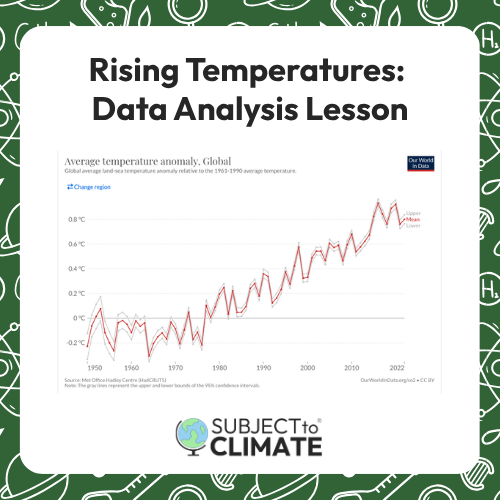
In this global warming lesson plan, students explore how mathematicians and scientists use data analysis and statistics to measure planetary warming, creating data tables, scatter plots, and linear regressions to make predictions using real National Weather Service data from their own community. The lesson features a Google Slides presentation, a student spreadsheet, a video that uses a simple metaphor to explain linear trends, and a discussion activity to address climate skepticism, with built-in differentiation that allows less experienced students to work with a single city while more advanced students compare multiple regions across the U.S.
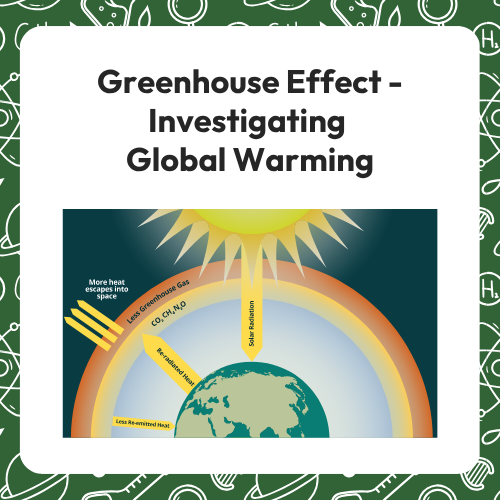
This experiment from the Environmental Science Institute is a perfect hands-on learning experience for middle school students exploring the greenhouse effect. Students create three environments in beakers: a control with only soil, one with soil and plastic wrap, and one with soil, plastic wrap, and increased carbon dioxide levels. They then monitor temperatures under a lamp, record data, and draw conclusions. The lesson includes detailed directions, background information on the greenhouse effect, and conclusion questions, and can be completed using Lab Pro software or by having students manually track temperatures as a team.
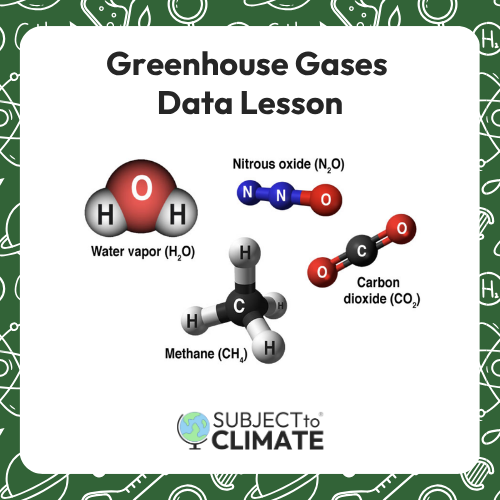
In this greenhouse effect lesson plan, students investigate real climate change data covering greenhouse gases, global temperature, ice melt, and sea level rise. Students begin by reflecting on what they already know about the four main greenhouse gases (water vapor, carbon dioxide, methane, and nitrous oxide), then collaborate in groups to analyze data from NOAA, NASA, and other resources before sharing their findings with the class. The data-driven format makes it a natural fit for both middle school Earth science and math classes, and the lesson wraps up with a written reflection, giving students the chance to synthesize what they have learned.
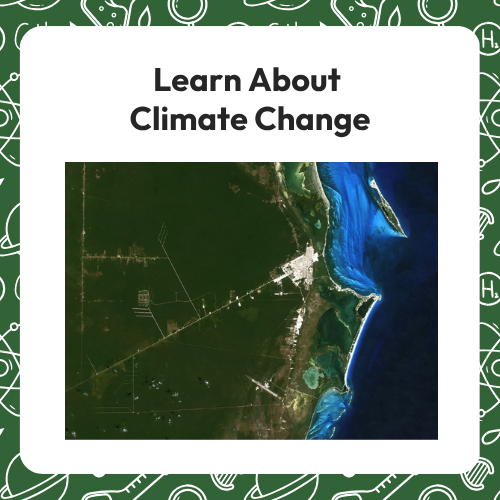
This lesson plan from Empatico provides educators with guidance for teaching middle school students about global warming, greenhouse gases, and how human activity has shaped the environment. Students watch a video on global temperature data, hear an analogy to help them understand the greenhouse effect, and examine images showing the real-world impacts of agricultural activity in Egypt, deforestation in Niger, and urbanization in Cancun, Mexico. A carbon footprint calculator adds a personal dimension to the lesson, encouraging students to reflect on their own greenhouse gas emissions and consider changes they can make to reduce their impact.
Greenhouse Effect Lesson Plans & Activities for High School
These four high school lesson plans take students beyond the basics of global warming, challenging them to think critically about the science, economics, and media surrounding climate change. From exploring the chemistry of the greenhouse effect to simulating real-world carbon pricing policies, each lesson encourages students to engage with complex, interdisciplinary ideas and develop the analytical skills needed to evaluate evidence and think like informed global citizens.
This interactive high school lesson is the third in the nine-part series from the King's Centre for Visualization in Science, guiding students through the chemistry and physics of the greenhouse effect at their own pace. Working independently through slides, students explore topics such as temperature and energy in Earth's atmosphere, properties of gases, radiation absorption and emission, and the differences among greenhouse gases, with built-in vocabulary support, visuals, and questions throughout. The self-paced format makes it a flexible option for varied class periods, homework, or substitute teacher days, and students can work individually, in pairs, or in small groups.
In this media literacy lesson, students watch three short videos on refrigeration gases and climate change, then use decoding questions to analyze each video's goals, intentions, and messages rather than just its content. The lesson develops critical thinking skills across multiple subjects, with discussion questions suitable for social studies, English language arts, science, and media literacy classes that can also be used as writing prompts. Teachers can use the activity for whole-class, small-group, or partner discussions and extend the lesson by having students fact-check the videos through independent research into refrigeration gases and alternative coolants.
This lesson plan introduces students to carbon pricing, cap-and-trade, and carbon taxes through a podcast, an article, and a hands-on climate simulation activity. After listening to the podcast, students work with the En-ROADS climate solutions simulator, trying to keep global warming under 2°C by adjusting greenhouse gas emissions across different sectors of the economy. The interdisciplinary lesson is a natural fit for science, civics, social studies, and geography classes, and teachers can extend it by having students examine carbon pricing models used around the world and consider which approaches might work in the United States.
This five-lesson unit from the National Center for Science Education guides high school students through analyzing data, media, and experiment results to understand the extent of climate change and how some people use information to downplay it. Students measure carbon in water, use a greenhouse effect simulation, and build a model exploring how ice affects the flow of energy, developing both scientific and media literacy skills along the way. The unit also introduces the DataWISE tool, which students can continue using for data analysis and source evaluation, and pairs well with other hands-on activities, such as the Amazing Albedo experiment, as an extension.
Finding the time to create full lesson plans is tough! These resources provide a complete greenhouse effect activity for any classroom. These lesson plans offer teachers a brief preview of the hundreds of resources on global warming and the greenhouse effect available from SubjectToClimate. SubjectToClimate provides a range of materials suitable for different grade levels, aligned with standards, and designed to make it easier for educators to teach climate-related topics. Be sure to check out the amazing videos, activities, experiments, podcasts, articles, and more to help your students understand how Earth’s changing atmosphere affects life on our planet and what we can do to stop it.
Join our Mailing List to receive resources directly to your inbox!
Teaching Climate Change to Middle School Students
Teaching Climate Change to High School Students
Integrating Climate Change Questions into Lessons
Author

Emily Rogers
Emily has a bachelor’s degree in English and French and a master’s degree in library and information science. She spent seven years teaching information evaluation and research skills as a school librarian in K-8 public schools. As a lifelong resident of Southern Louisiana, Emily has a particular interest in how climate change affects coastal regions. She hopes to connect educators with resources that will help them to teach their students about the disproportionately adverse effects of climate change on historically marginalized communities.
Some Resources in this Guide Provided by Our Partners: