Rivers Meandering
Provided by: Google Earth|Published on: April 27, 2021|Last updated: July 16, 2026
Grades: 6, 7, 8, 9, 10, 11, 12
Type: Data, Graphs, and Maps
Subjects: Biology, Physics, Earth and Space Sciences
Authors: Google Earth
Location: South America

This resource has been reviewed by SubjectToClimate's climate scientists and verified for scientific accuracy and up-to-date information. Learn about our review process →
This resource has been reviewed by SubjectToClimate's climate scientists and verified for scientific accuracy and up-to-date information. Learn about our review process →
Synopsis
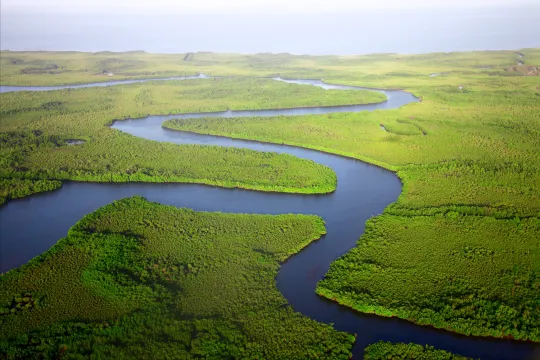
- This interactive resource allows students to explore satellite imagery of a meandering natural river in Bolivia, with images beginning in 1985.
- Students will observe the river naturally change course and leave behind oxbow lakes as it meanders through time.
Teaching Materials
Positives
- Pausing the progression of images allows students to compare the images from different years and identify all of the changes.
- Students may have never seen a river in its natural state, so this might be very helpful in explaining natural processes or the ability of humans to change the landscape.
Additional Prerequisites
- If you are using wireless or a slow Internet connection, the images may take longer to load.
- Other time-lapse images can be found in this Google Earth Timelapse resource.
Differentiation
- Students could work in groups to identify where the river changed course and anticipate future changes.
- Connections with art classes could be made by having students draw or paint the river from different years side-by-side to illustrate the changes.
- Physics classes could evaluate the fluid dynamics and sedimentation locations to predict future changes.
- Biology and science classes could explore how changing the flow of a river with dams, cement armor, or channels can affect the river ecosystem and cause other unintentional changes, such as the loss of land at the mouth of the Mississippi River in Louisiana or an increase in methane emissions from reservoirs.
The resource presents a spatiotemporal change in river meandering. Climate change impacts caused disappearance and depositions, creating new tributaries and flow patterns. Students can explore to see these changes and new features it has created over time. The resource is recommended for teaching.
Teaching Tips
Standards
Resource Type and Format
Scientist Reviewed
This resource has been reviewed by SubjectToClimate's climate scientists and verified for scientific accuracy and up-to-date information. Our review process ensures that every resource in our library reflects the current state of climate science.
Learn about our review process →