
Total Lunar Eclipse Tonight for North, South America
March 13, 2025

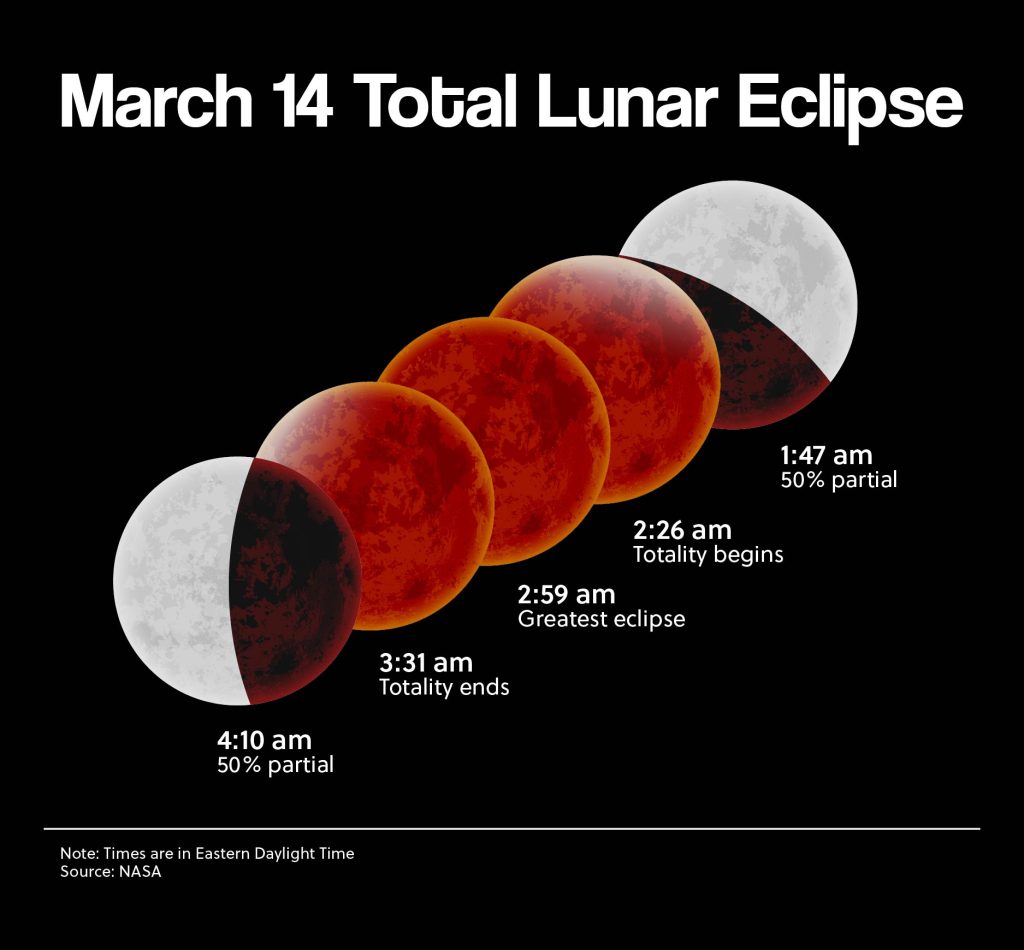
If you happen to find yourself looking up at the sky late tonight, don’t be alarmed by the rust-red shade of the moon. It's experiencing a total lunar eclipse.
The event will be visible starting at 1:09am on the US East Coast. Anyone in North or South America can see it, as long as the sky is clear. The moon will appear dark and red. The change will last for an entire hour. It's caused by Earth revolving its way directly between the sun and the moon.
But if Earth is completely blocking the moon from the sun, how will we be able to see it? And why will it appear red? The answer has to do with how Earth’s atmosphere scatters the light of the sun’s rays.
Each ray of light is made up of wavelengths that the human eye perceives as different colors. Those wavelengths react in different ways when they slam into the atoms that make up our sky. If they hit our atmosphere from directly above, like at noon, blue wavelengths get scattered. That scattering of blue is what we see above us on a beautiful day.
If the sun’s rays only graze Earth, like they do at sunset, red and orange wavelengths get scattered, and that’s what we see. As they pass by Earth, those rays get bent and cast upon the moon. That, NASA says, is how we get our “blood moon” during a lunar eclipse.
“It’s as if all the world’s sunrises and sunsets are projected onto the Moon,” NASA wrote in a statement.
Reflect: If you could witness any rare or magical event in the night sky, what would it be and why?
News brought to you by 
Read More News Stories Today!