Solar Probe Makes History Flying Closer and Faster to Sun than Ever
January 2, 2025

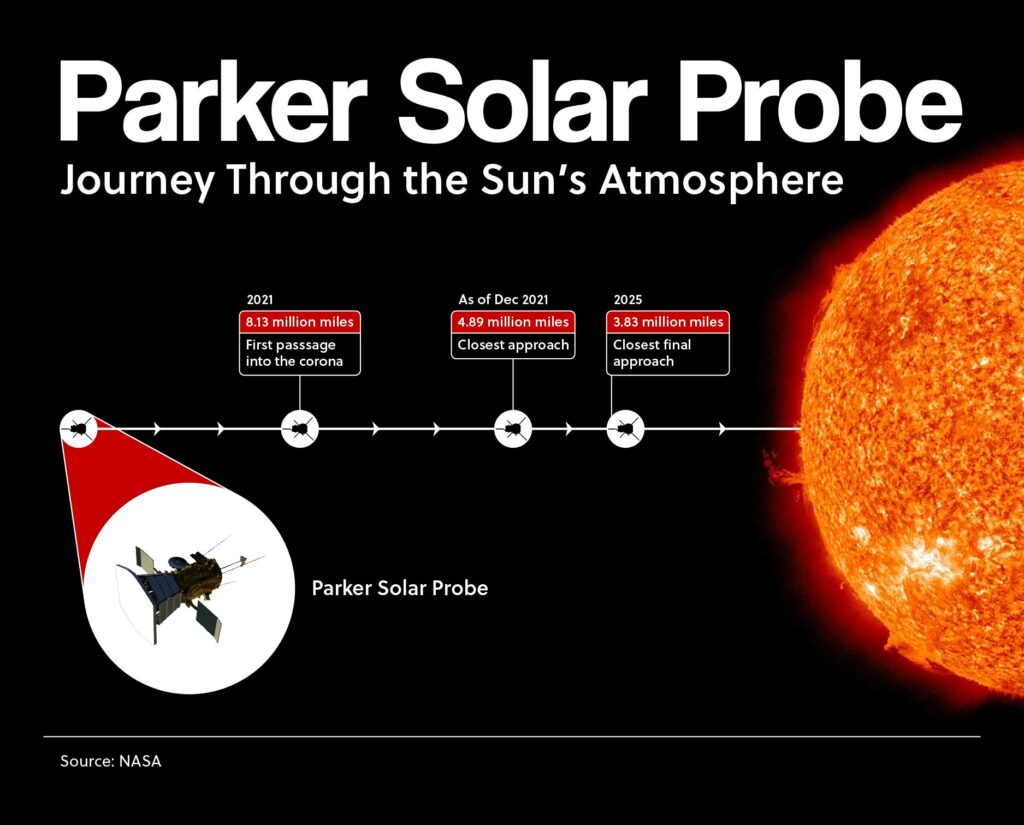
The Parker Solar Probe is on a six-year mission to “touch” the sun. It achieved its main goal Christmas Eve when it pierced our star’s corona at a speed faster than any other spacecraft in history.
Ecstatic NASA scientists confirmed the feat two days later. That's when the probe sent a signal to Earth proving it had come within 3.83 million miles of the sun’s surface. It was traveling at a speed of 430,000 miles per hour (mph). That's .064% the speed of light. It was the probe’s speediest and closest approach to the sun. The probe has orbited the sun 18 times.
The probe broke through plasma plumes from the sun. It came close enough to enter a solar eruption. Scientists compare that to a surfer riding underneath a wave.
"This is a major engineering accomplishment," Adam Szabo said on NASA's website. He's a probe project scientist. Szabo’s colleague, Nour Raouaf, has called the Parker Solar Probe mission “equivalent to the moon landing of 1969."
The probe is named after Eugene Parker. He was a University of Chicago physicist. Parker came up with the theory that solar winds exist. The probe is trying to find out how these winds form and the source of their million-plus mph speeds, among other things.
Solar winds can be found across the solar system. They create spectacular aurora on Earth. But they can disrupt satellite electronics. They also affect communications signals. They can threaten astronauts with radiation.
The probe has gathered speed via “gravity assists” from Venus. It's repeatedly passed Venus in a perpetual orbit between the planet and the sun. That has led to unexpected surprises.
In July 2020, the probe’s infrared camera broke through Venus’ thick clouds and took pictures of the planet’s red-hot surface. It is 869 degrees Fahrenheit on Venus.
Reflect: What do you think are some of the most exciting discoveries we could make by exploring the sun and other planets in our solar system?
News brought to you by 
Read More News Stories Today!