Mars Likely Had an Ocean and Beach, But You Couldn't Sunbathe There
February 26, 2025

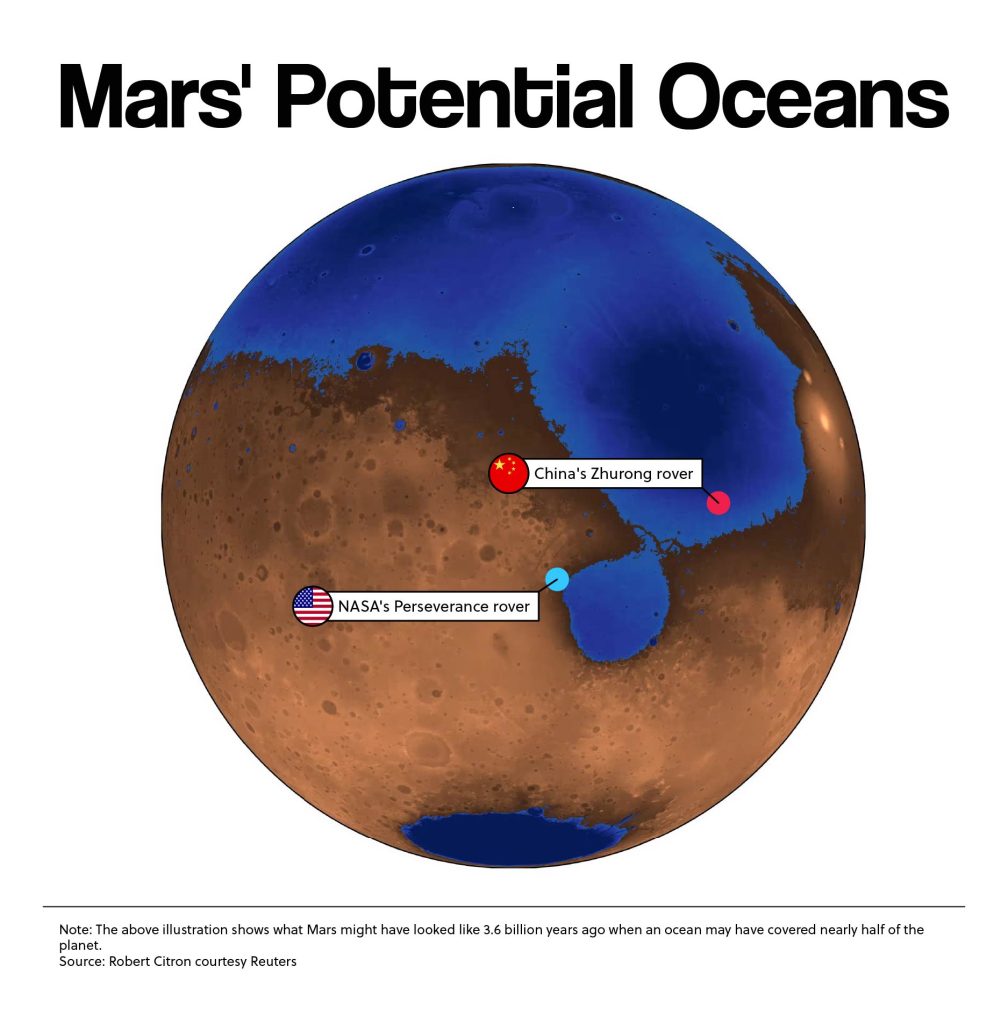
Mars, also called the Red Planet, is known to scientists as an arid planet filled with rocky surfaces. It's not known for its beaches. But a research team now believes it has found evidence that Mars has buried beaches. That would mean the small planet once featured an ocean.
Experts are debating the topic. The findings are based on underground imaging data supplied by China’s Zhurong rover. They were released this month in a paper appearing in the Proceedings of the National Academy of Sciences.
The research team wrote that radar imaging beneath Mars' surface appears similar to that of shorelines on Earth. Both reveal material below the surface that are tilted in the same angle. They tilt toward the lowland or an ocean.
“It’s a simple structure, but it tells you there had to be tides, there had to be waves, there had to be a nearby river," Dr. Benjamin Cardenas told The Guardian. He's a co-author of the research from Penn State University. He added, "All these things had to be active for some extended period of time."
Other activities could result in such tilted structures. But they don’t fit the makeup of Mars. “We rule out volcanic (activity), rivers, and wind-blown sand dunes. All of these are pretty commonly seen on Mars, but the structure just doesn’t fit any of them,” Cardenas said.
Despite this theory, a beach on Mars would not feature warm sunshine and palm trees. Mars is a cold planet. Experts believe it has likely been that way throughout its history.
“That said, I’d love to have seen it. Doing geology, reconstructing these ancient landscapes, it really is excellent daydream fuel,” Cardenas told The Guardian.
Reflect: What does the discovery of ancient oceans on Mars make you wonder about the planet’s past and future?
News brought to you by 
Read More News Stories Today!