Little Monkey, Big Roar — And Orange Lips
July 22, 2026

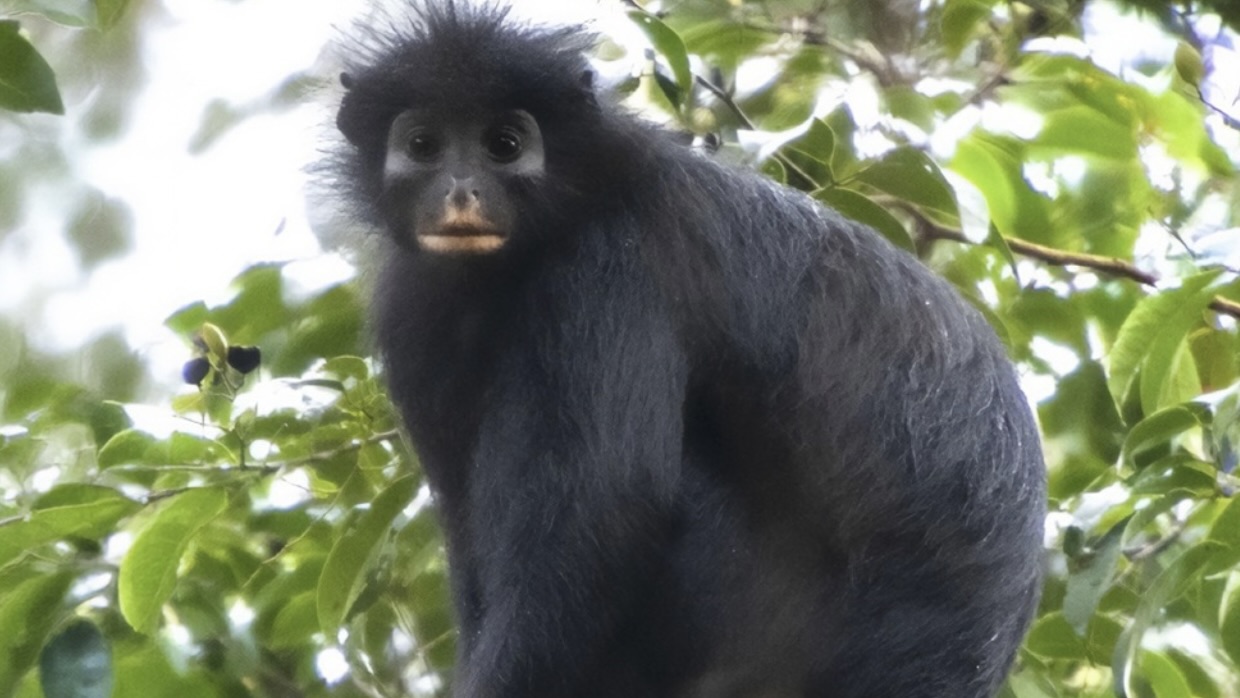
For years, experts had long heard rumors of a strange monkey. It was said to have bright orange lips. It lived high in the trees of Lomami National Park in the Democratic Republic of Congo. But no one could prove the money was real. People called it the Likweli. Now, there is new proof it exists. The little monkey can join its cousins as an official species.
At first, the search for the Likweli sounded like the hunt for Bigfoot. There was one blurry photograph from 2008. There were also a few stories told by local tribes. They spoke of a “roaring” monkey with bright orange lips. From 2018-2022, park officials worked with a research team at Florida Atlantic University (FAU) and the National Geographic Society. The team did 52 interviews and made 114 observations. In the end, they had their answer. The Likweli is real.
The Likweli is “only the fifth new monkey species in Africa identified in the past 75 years,” the team wrote in a press release. Scientists studied the monkey's genes and its body. These tests showed it was "a distinct species." The monkey is “separated from its closest relative by 4 to 5 million years of evolution," the team added.
To figure out whether the Likweli was truly new, the team studied a number of monkeys captured by hunters. They tested the animals' DNA. The tests showed the orange-masked monkey was different from two other monkey species that live in Lomami Park. They named the new species Colobus congoensis. It is the first primate species named for the Congo.
The Likweli is already considered highly endangered. It lives in a small strip of forest. That forest is shrinking as humans cut it down.
“The discovery of Colobus congoensis is both a scientific triumph and a sobering reminder," said FAU biologist Kate Detwiler. She warned that "some of Earth’s rarest creatures may vanish before the world even knows they exist."
Reflect: What's something you always believed was real before anyone could prove it?
Photo of Likweli courtesy FAU press release.
News brought to you by 
Read More News Stories Today!