Kenya's Northern White Rhinos Could Return From Brink of Extinction
January 8, 2025

Thought Question: If you could help save an animal species from disappearing forever, what would it be and how would you do it?
Kenya’s northern white rhino population has dwindled to just two rhinos. And most experts feared the subspecies would go extinct upon their future deaths. But scientists now hope that they can use invitro-fertilization (IVF) methods to keep the subspecies alive.
In Sudan, the last living male northern white rhino died last March. This left behind only two females. These females are Najin and her daughter Fatu. Both live in a conservancy in Kenya. They are the most endangered subspecies of mammal in the world.
Now, Thomas Hildebrandt is working to solve the problem. He works with the Leibniz Institute for Zoo and Wildlife Research in Berlin, Germany. And he has written in the journal Nature that he's also working with an Italian biotech company. The team has produced viable white rhino embryos through the IVF process.
IVF is a complex medical process. During it, a female’s egg is fertilized by a male’s sperm. This occurs in a test tube or somewhere in a lab. Then, the fertilized eggs, called embryos, are placed in a female’s uterus. From there, a baby can grow.
Both Najin and Fatu appear unable to conceive from sperm that has been stored from Sudan and other white rhinos. So scientists say they'll need to take eggs from the female rhinos’ ovaries. They'll then combine them with sperm in a lab setting.
Even if IVF works with the two northern white rhinos, it still could be hard to save the subspecies. Any offspring would need to be bred with each other. But their DNA will be very closely aligned. This could create biological fitness problems. However, a similar IVF process recently was a success in southern white rhinos, Hildebrandt wrote in Nature, offering a chance for their northern cousins.
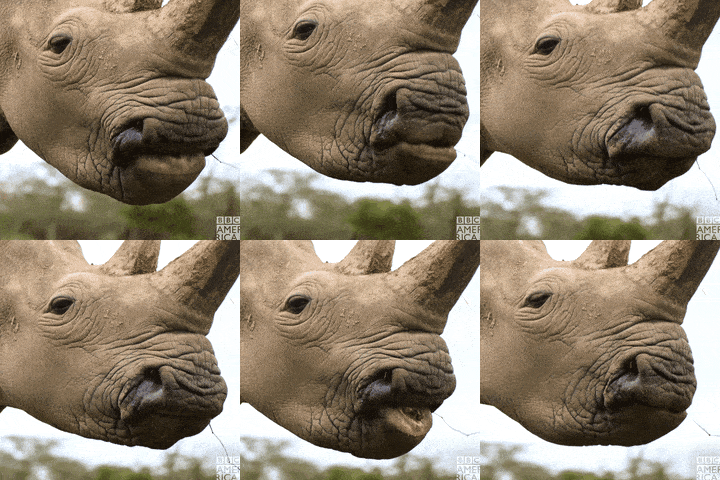
Gif of Northern white rhino from GIPHY.
News brought to you by 
Read More News Stories Today!