
'He's Tiny!' 'It's Blue!' 'It's Beautiful!': New Species of Octopus Has Scientists Squealing
June 1, 2026

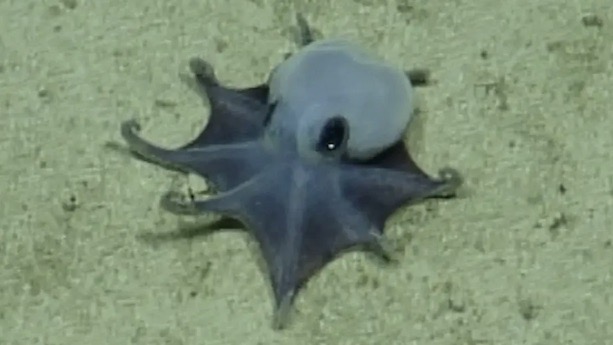
Octopus expert Janet Voight had seen pictures of the roly-poly, pouty-eyed, golf-ball-sized blue octopus discovered off the coast of the Galápagos Islands in 2015. But neither she nor any other marine biologist knew exactly what it was.
They all agreed it was adorable, though.
“Is that a cute little guy, or what?” one observer gushed. Another researcher cried, “He’s tiny! It’s blue!” They were part of the crew of a Charles Darwin Foundation mission. It sent an unmanned submarine 5,900 feet down to the ocean floor. It recorded footage of the tiny octopus.
Scientists were smitten with its appearance. But they couldn’t identify the octopus without looking closer. For Voight, that opportunity finally came in 2022. The Galápagos National Park Directorate managed to obtain and preserve one of the creatures.
"When it arrived, I was like 'Oh! My goodness! It's beautiful,'" Voight told Agence France-Presse.
The specimen was so delicate that Voight didn’t dare dissect it. Instead, she took thousands of X-rays. She used them to make a 3D model. Then she examined its tentacles, beak, eyes, and other markers. Doing so revealed that the octopus was a member of a species never before observed by humans. Voight named it Microeledone galapagensis. She published her research in May in the journal Zootaxa.
“These are little octopuses that live in the deep sea, and hardly anybody on Earth has ever gotten to see them. I just feel lucky that I got to work with them,” Voight said in a written statement. “If you took all the land on Earth and pieced it together, you would not cover the Pacific Ocean. The oceans are so big, and there’s so much left to explore.”
Reflect: What is something you are really curious about, and why do you want to know more about it?
Photo of Microeledone galapagensis courtesy Field Museum press release/Charles Darwin Foundation.
News brought to you by 
Read More News Stories Today!