Bonobos May Play Pretend, Study Shows
March 16, 2026

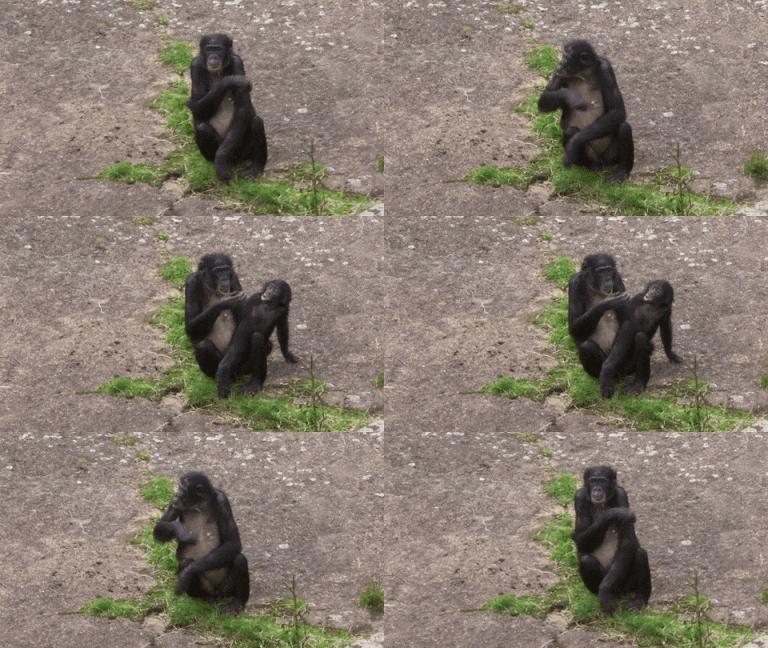
The authors of a  study published this month in the journal Nature had a simple but important question: Are humans the only species who can engage in pretend play?
Amalia Bastos and Christopher Krupenye are primate specialists. They work at Johns Hopkins University. They'd heard stories of humans’ closest relatives, the great apes, engaged in what appeared to be pretend play. Chimpanzees had been seen in Uganda carrying sticks with multiple limbs as though they were babies. In 2002, a captive chimp was recorded mimicking moving around his favorite blocks. Yet, he didn’t have them at the time. Bastos and Krupenye wondered if such examples could be replicated.
Bonobos are close relatives of chimps. Working with Kanzi, a bonobo, the researchers set up a series of experiments. First, they showed Kanzi two bottles. One was filled with juice. The other was empty. Using sign language, they asked Kanzi to pick which bottle held juice. Kanzi got it right each time. Next, they showed Kanzi two empty cups. Then, they pretended to pour juice into one of them. When asked to find the juice, Kanzi picked the “full” cup 68% of the time. He did even better if one cup was filled with real juice and the other was filled with pretend juice.
Bastos and Krupenye repeated the trials with grapes. They found that Kanzi did just as well.
“What’s really exciting about this work is that it suggests that the roots of this capacity for imagination are not unique to our species,” Krupenye told The Associated Press (AP).
Both primate specialists stress that Kanzi’s success with the trials isn’t complete proof that all apes can pretend. But Kanzi “opened this path for a lot of future studies,” Bastos told the AP.
Reflect: What kinds of abilities do you wonder that animals might have that we haven’t learned about yet?
Gif of bonobos from Giphy.
News brought to you by 
Read More News Stories Today!