Wildfires and Environmental Justice Lesson
Lesson Plan
1 hour 30 minutesGrades6, 7, 8Geography
This resource has been reviewed by SubjectToClimate's climate scientists and verified for scientific accuracy and up-to-date information. Learn about our review process →
Written by Beth Oehler, Oregon Educators for Climate Education
About this lesson
In this lesson, students will examine the 2020 Almeda Fire in Oregon and explore the disproportionate impacts of wildfires.
Step 1 - Inquire: Students discuss wildfires, wildfire impacts, and climate emotions and explore a wildfire simulator.
Step 2 - Investigate: Students learn about the connection between climate change and wildfires and examine the Almeda Fire by watching a video, reading an article, and answering comprehension questions.
Step 3 - Inspire: Students choose from a menu of action-oriented options to demonstrate their knowledge of wildfires and their disproportionate impact on marginalized communities.
Preview the lesson plan
Better on a bigger screen? Open it in its own tab.View Lesson Plan
Everything you need to teach it
How to edit these materials (video)Teaching tips
Positives
- This lesson clearly explains the connection between climate change and wildfires.
- This lesson allows students to realize how wildfires disproportionately impact different groups of people. It provides space for students to better understand the concept of climate justice.
Additional Prerequisites
- Be sensitive to the needs of your students if they have been personally impacted by wildfire. Depending on the circumstances, this lesson may not be appropriate or may need to be adapted for your class.
- This lesson assumes that students have prerequisite knowledge of climate change, including understanding the basic science behind climate change.
- Each student will need access to a device in order to play with the Wildfire Simulation. If each student does not have a device, students may share devices. If there are no devices for students, teacher can project and play with the Wildfire Simulation on an interactive whiteboard.
Differentiation
- Pay close attention to how student groups are formed in the jigsaw activity during the Investigate section. Students will be jointly constructing meaning from reading different parts of the article. Groups of students with varying reading levels will probably work best, as high-achieving peers can model meaning-making for students at lower reading levels.
- It may be best to steer students toward one or more options in the menu in the Inquire section, depending on their ability and preference for demonstrating their knowledge.
- In the Inquire section, it may not be possible for any or all of your students to create a wildfire emergency supply kit. Gathering and paying for all of those items is expensive. Be sensitive to your students. In some cases, it may be best to remove that option from the menu before sharing it with your students.
From the scientist review
This engaging lesson helps students comprehend what wildfires are, the climatic factors that could start them and speed up their spread, and the potential losses and harm that they could do to vulnerable and marginalized populations. The wildfire simulator has been evaluated and is suitable for use by students. Additionally, the lesson's videos and other supporting resources have been examined, and this lesson has passed our science credibility process.
Want this to fit your class?
Add your location for local examples, questions, and action ideas.
About the teacher writers
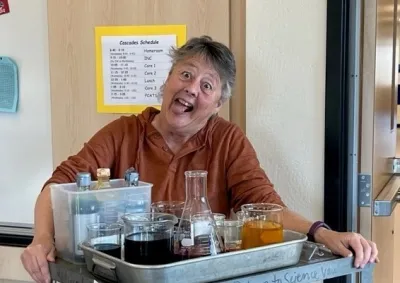
Beth Oehler
Having been a teacher at AMS for 28 years, Beth Oehler may very well be the longest-tenured member of the Ashland Middle School staff. Hired right out of SOU’s teaching program in 1995 by then-principal Dale Rooklyn, Beth has been a Math, Science, and/or Social Science teacher ever since. In answer to the question of what gets her out of bed every morning, she says, “I get a lot of energy from the kids, and I enjoy having fun with them. I am inspired by working with future change-makers who will solve problems and make positive change in the world.”
Back in 1995, AMS had 900 students in just one building; the big gym and the 7th/8th grade building didn’t exist yet. Currently, Beth is teaching 6th grade Science and Social Studies on the Cascades team in the newly constructed 6th grade wing. About her new classroom at AMS, Beth says, “I love my large, bright space with lots of storage. I have the ability to set up a lab and teach in the same classroom. It’s fantastic!”
An animal lover, Beth fosters kittens for the Animal Shelter and has a faithful dog companion, Journey. In addition to animals, her other love is travelling; she has travelled to 6 continents and all 50 states, but her favorite is still Oregon.
Bio from: https://www.ashland.k12.or.us/o/ams/article/932750
Bio from: https://www.ashland.k12.or.us/o/ams/article/932750

Oregon Educators for Climate Education
Website: https://www.oregonclimateed.org/
Oregon Educators for Climate Education (OECE) is a statewide group of educators working toward Oregon legislation that would mandate the integration and infusion of climate change for PK-12 education across all core subject areas.
Our steering committee is comprised of current and retired K-12 educators, as well as high school students. While most of us reside and work in the Willamette Valley, we are seeking connection and input from stakeholders from regions across Oregon. We are inclusive and invite diverse voices to join us!
Website: https://www.oregonclimateed.org/