
What's Killing Minnesota's Moose?
Provided by: Vox|Published on: April 27, 2021|Last updated: July 16, 2026
Grades: 6, 7, 8, 9, 10, 11, 12
Type: Videos
Subjects: Biology
Authors: Vox
Location: North America > United States > Minnesota

This resource has been reviewed by SubjectToClimate's climate scientists and verified for scientific accuracy and up-to-date information. Learn about our review process →
This resource has been reviewed by SubjectToClimate's climate scientists and verified for scientific accuracy and up-to-date information. Learn about our review process →
Synopsis
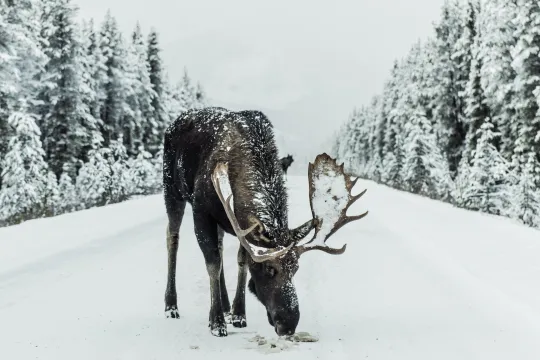
- This video describes the decline of moose populations in northern Minnesota, details the ecological reasons behind this problem (including shifting populations of parasites and predators), and highlights the effects on the native Anishinaabe (or Ojibwe) people.
- Wildlife biologists share their research results linking the moose decline to climate change and interviews with Anishinaabe or Ojibwe individuals reveal their cultural connection to (and reverence for) the moose.
Teaching Materials
Positives
- Scientific research with multiple lines of evidence are clearly provided to describe the declining moose populations in Minnesota.
- Indigenous voices are highlighted throughout the video, describing the impact that climate change has on their historic way life.
Prerequisites
- Students should be familiar with predator-prey relationships.
- Students should be able to describe cause and effect relationships in ecological problems.
- There may be a commercial before and during the video.
Differentiation & Implementation
- Consider having students create a concept map that highlights the problem of declining moose populations and the various causes of this decline that are all a result of climate change.
- Have students choose to research another animal that is affected by climate change and explain the ecological reasons for the decline.
This resource is a 10-minute video presenting the historic dependence of the Anishinaabe or Ojibwe indigenous communities in Minnesota on moose populations, which are currently experiencing a startling population decline. This resource presents compelling evidence that points to changes due to increasing temperatures, rather than overhunting, as the cause of moose population decline. This is a very well-produced resource and is recommended for teaching.
Teaching Tips
Standards
Resource Type and Format
Scientist Reviewed
This resource has been reviewed by SubjectToClimate's climate scientists and verified for scientific accuracy and up-to-date information. Our review process ensures that every resource in our library reflects the current state of climate science.
Learn about our review process →