The Tip of the Iceberg
Provided by: Universities Space Research Association|Published on: October 31, 2023|Last updated: July 16, 2026
Grades: 2, 3, 4, 5
Type: Activity - Classroom
Subjects: Science
Authors: Universities Space Research Association
Location: Earth

This resource has been reviewed by SubjectToClimate's climate scientists and verified for scientific accuracy and up-to-date information. Learn about our review process →
This resource has been reviewed by SubjectToClimate's climate scientists and verified for scientific accuracy and up-to-date information. Learn about our review process →
Synopsis
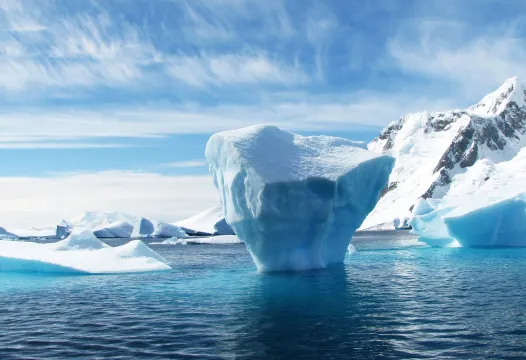
- In this experiment, students observe ice cubes in water to understand the buoyancy of ice in water, how chunks of ice can impact water levels, and the density of ice compared to water.
- In addition to the experiment, students will review related concepts, analyze the experiment's results, record their findings in a journal, and have a post-experiment discussion about icebergs.
Teaching Materials
Positives
- This experiment can be completed in one class period.
- The required materials for this experiment are relatively easy to find.
Additional Prerequisites
- Students need to have a basic grasp of fractions.
- It's a good idea to do the Amazing Expanding Ice experiment before doing this one.
Differentiation
- This experiment can fit within a larger unit on the distinct qualities of water and how these attributes manifest in the natural world.
- To extend the experiment, teachers can encourage students to observe and record how melted ice impacts the containers' water level.
- This experiment can support a classroom discussion on why icebergs are important for the environment.
- This experiment can augment a classroom discussion on how melting icebergs impact global sea levels.
This resource is from the CLEAN collection. “The CLEAN collection is hand-picked and rigorously reviewed for scientific accuracy and classroom effectiveness.”
Teaching Tips
Standards
Resource Type and Format
Scientist Reviewed
This resource has been reviewed by SubjectToClimate's climate scientists and verified for scientific accuracy and up-to-date information. Our review process ensures that every resource in our library reflects the current state of climate science.
Learn about our review process →