Sponge City: An Ecosystem Engineering Case Study
Provided by: PBS|Published on: April 14, 2026|Last updated: July 16, 2026
Grades: 9, 10, 11, 12
Type: Videos
Subjects: Engineering
Authors: PBS
Location: Asia

This resource has been reviewed by SubjectToClimate's climate scientists and verified for scientific accuracy and up-to-date information. Learn about our review process →
This resource has been reviewed by SubjectToClimate's climate scientists and verified for scientific accuracy and up-to-date information. Learn about our review process →
Synopsis
- This video features landscape architect Kongjian Yu's solution to the impacts of pollution in Haikou, China on a downstream mangrove forest.
- The resource includes a variety of support materials for students to evaluate the nature-based solution, evaluate their own local watershed, and discuss whether this nature-based solution can be used anywhere else.
Teaching Materials
Positives
- The architect's model is great for helping students visualize and understand the solution.
- Students will enjoy the interactive mapping activity and finding their own watersheds.
Prerequisites
- Students should understand the importance of carbon sequestration in mitigating climate change.
- Because it is briefly mentioned, it may also benefit students to understand how climate change influences sea level rise.
- The instructions for navigating the map may be incorrect. For example, the layer list may be on the right-hand side of the map, rather than along the top. Instead of checking a box next to the Watershed Boundary Dataset, students will need to click on the eye with a line through it.
Differentiation & Implementation
- Students can create flashcards for the vocabulary terms, adding to their flashcards an image they feel best represents that term.
- This resource can be used in conjunction with this lesson on the importance of mangrove forests.
- Teachers can use this lesson to make connections to the Sustainable Development Goals, demonstrating the interconnection between SDG 6, Clean Water and Sanitation, SDG 11, Sustainable Cities and Communities, and SDG 15, Life on Land.
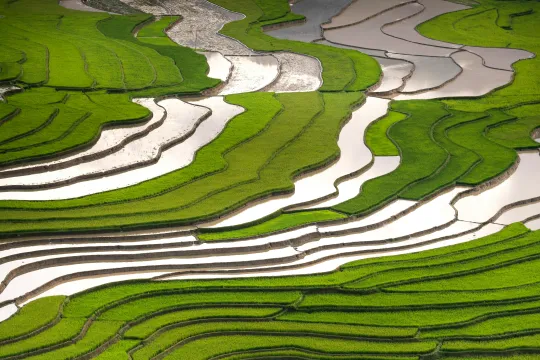
This resource details a case study of river restoration using natural solutions informed by traditional terraced paddy landscapes. Rightly likened to a sponge, this ecosystem’s role in removing water pollutants and storing carbon is highlighted. Most notably, a GIS activity engages students in understanding their home watershed and planning if "rewilding" may be appropriate. This resource is recommended for teaching.
Teaching Tips
Standards
Resource Type and Format
Scientist Reviewed
This resource has been reviewed by SubjectToClimate's climate scientists and verified for scientific accuracy and up-to-date information. Our review process ensures that every resource in our library reflects the current state of climate science.
Learn about our review process →