Solar Tilt Investigation 6-12
Provided by: Wisconsin Center for Environmental Education|Published on: August 2, 2023|Last updated: July 16, 2026
Grades: 5-12
Type: Lesson Plans
Subjects: Physics, Mathematics, Engineering
Authors: K-12 Energy Education Program, Wisconsin Center for Environmental Education
Location: Earth, North America > United States > Wisconsin

This resource has been reviewed by SubjectToClimate's climate scientists and verified for scientific accuracy and up-to-date information. Learn about our review process →
This resource has been reviewed by SubjectToClimate's climate scientists and verified for scientific accuracy and up-to-date information. Learn about our review process →
Synopsis
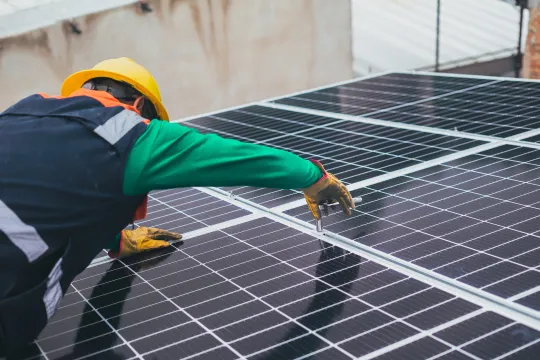
- In this inquiry-based lesson, students will perform experiments to determine if the angle at which the sun shines on a solar panel affects the amount of energy it produces.
- Students will also learn about careers in solar energy and how solar energy can reduce carbon emissions.
Teaching Materials
Prerequisites:
- Ensure students are familiar with angle measurement, including using a compass.
- Consider defining the terms variable, dependent variable, independent variable, hypothesis, null hypothesis, alternative hypothesis, voltage, horizontal, vertical, renewable, nonrenewable, electrons, radiation, commercial, residential, equitable, efficiency, retrofit, and others prior to beginning the lesson.
- Ensure students know how to graph positive and negative integers.
Preparation:
- There are many tools needed for this lesson that may not be readily available in every classroom. Make sure you can get access to these tools prior to using this lesson.
Extensions:
- Students look into putting solar panels in their own school or can investigate their school's preexisting solar panels.
- Students find a local solar installer or solar design engineer and interview them, or can research a career using the solar career map.
- Use extra articles about solar accessibility on slide 29 in a jigsaw reading activity.
Differentiation:
- Use strategic pairing or do the activity as a whole class if some students struggle with using a compass to measure an angle or with graphing points.
- Check out KEEP's Solar Tilt Kit to support this lesson and access a companion lesson for K-5 students.
Interdisciplinary Connections:
- Social Studies:
- Students discuss how inequality and discrimination are connected to energy. They can then list the things other cities and organizations are doing to address this.
- After watching the Project Drawdown video on slide 37, students discuss which sector they would like to learn more about, why certain sectors may get a disproportionate amount of attention, and what they (as individuals) can do to make a difference.
The tilt of the Earth in relation to the Sun is an important factor in our climate system. Similarly, the angle of a solar panel in relation to the Sun is an important factor in generating electricity. This in-class experiment allows to students explore how a changing angle changes solar energy production. This resource is recommended for teaching.
Teaching Tips
Standards
Resource Type and Format
Scientist Reviewed
This resource has been reviewed by SubjectToClimate's climate scientists and verified for scientific accuracy and up-to-date information. Our review process ensures that every resource in our library reflects the current state of climate science.
Learn about our review process →