Power of Forests
Provided by: The Nature Conservancy|Published on: April 29, 2026|Last updated: July 16, 2026
Grades: 6, 7, 8
Type: Lesson Plans
Subjects: Biology
Authors: Nature Lab by The Nature Conservancy
Location: Earth
This resource has been reviewed by SubjectToClimate's climate scientists and verified for scientific accuracy and up-to-date information. Learn about our review process →
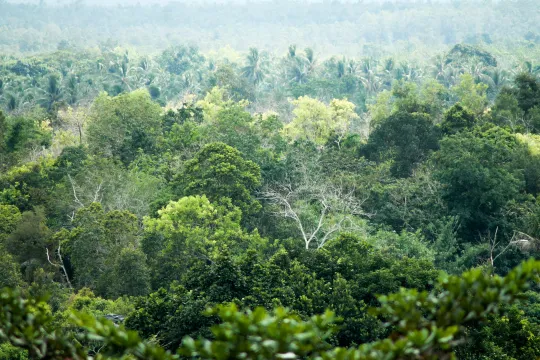
This resource has been reviewed by SubjectToClimate's climate scientists and verified for scientific accuracy and up-to-date information. Learn about our review process →
Synopsis
- This three-lesson unit introduces students to the ecosystem services provided by forests and the methods by which we can care for them.
- Through experiments, games, and short videos, students will understand how forests sequester carbon, support biodiversity, and provide resources for the communities that care for them.
- The notion that farming always leads to deforestation is challenged by the presentation of traditional Indigenous milpa farming, where farm fields are maintained without cutting forest trees.
Teaching Materials
Positives
- The background section for the first lesson includes a very relatable example to help students understand the greenhouse effect.
- Each worksheet includes a section that explains what students can do to help, empowering them to turn what they have learned into action.
Prerequisites
- Video links and other links do not automatically open in a new tab. Teachers may want to advise students accessing the curriculum to do this manually to avoid losing their place.
- For the activity in the first lesson, students will need 2 large clear glass jars, plastic wrap, 2 thermometers, matches or a small candle, a lamp or heat source, and a timer or stopwatch. For the activity in the second lesson, students will need string and index cards that teachers will prepare with the list of organisms. For the activity in the third lesson, teachers will need to print the provided cards on cardstock.
Differentiation & Implementation
- For each section, students can select one vocabulary term to create a small poster for, resulting in a class-made word wall for the unit.
- Teachers can have students complete the background reading and the Watch & Reflect activity as homework in preparation for the hands-on experiments to be performed in class.
- In the Watch Guide, the lines for the fill-in-the-blank portion are quite small and may frustrate students with large handwriting. Teachers can have students number the lines instead, writing the answers on a separate sheet of paper alongside coordinating numbers.
- There are many opportunities in these lessons to make connections to Sustainable Development Goal 15, Life on Land.
This learning module introduces students to forests across the globe, with a focus on carbon sequestration and biodiversity. This resource is strongly grounded in climate science and is recommended for teaching.
Teaching Tips
Standards
Resource Type and Format
Scientist Reviewed
This resource has been reviewed by SubjectToClimate's climate scientists and verified for scientific accuracy and up-to-date information. Our review process ensures that every resource in our library reflects the current state of climate science.
Learn about our review process →