Irrigation Efficiency
Provided by: Western Landowners Alliance|Published on: August 20, 2026|Last updated: August 23, 2026
Grades: 9, 10, 11, 12
Type: Articles/Websites
Subjects: Biology, Earth and Space Sciences, Economics, Geography
Authors: Thomas Plank
Location: North America > United States > Colorado
This resource has been reviewed by SubjectToClimate's climate scientists and verified for scientific accuracy and up-to-date information. Learn about our review process →
This resource has been reviewed by SubjectToClimate's climate scientists and verified for scientific accuracy and up-to-date information. Learn about our review process →
Synopsis
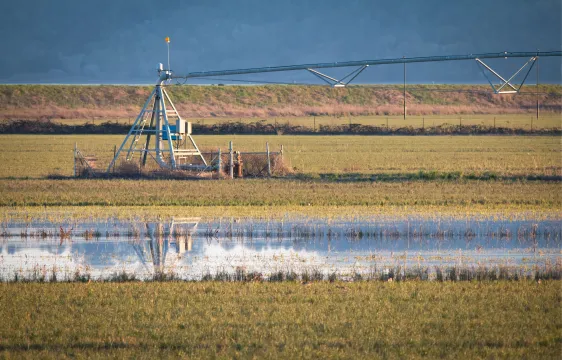
- This article questions the common assumption that more efficient irrigation always conserves water, drawing on a study of flood irrigation along the White River.
- Students learn that water from traditional flood irrigation seeps underground and returns to the river and wetlands over months, supporting springs, wildlife, and the wider community, a benefit that more efficient sprinklers can reduce.
- The article introduces the idea of ecosystem services and shows how a practice that looks wasteful can play an important role in a watershed under a warming climate.
Teaching Materials
Classroom Implementation:
- Before reading, ask students to predict whether switching from flood irrigation to sprinklers saves water, then revisit their predictions afterward to surface the counterintuitive finding.
- Define and use the term "ecosystem services" as an anchor concept and have students list the specific services flood irrigation provides in this case, then discuss how these might be valued in decisions.
Extensions:
- Create watershed models and conduct an experiment to compare the two practices.
- Use this ecosystem services assessment activity to notice and categorize the ecosystem services of an environment.
Sustainable Development Goals Connections:
- This resource can be used to make connections to Sustainable Development Goal 6, Clean Water and Sanitation, and Sustainable Development Goal 15, Life on Land.
Teaching Tips
Standards
Resource Type and Format
Scientist Reviewed
This resource has been reviewed by SubjectToClimate's climate scientists and verified for scientific accuracy and up-to-date information. Our review process ensures that every resource in our library reflects the current state of climate science.
Learn about our review process →