"Quahog, Records of A Changing Ocean"
Provided by: Jill Pelto Gallery|Published on: June 6, 2023|Last updated: July 16, 2026
Grades: 11, 12, AP
Type: Articles/Websites
Subjects: Biology, Visual and Performing Arts
Authors: Jill Pelto Gallery
Location: North America, North America > United States, North America > United States > Maine

This resource has been reviewed by SubjectToClimate's climate scientists and verified for scientific accuracy and up-to-date information. Learn about our review process →
This resource has been reviewed by SubjectToClimate's climate scientists and verified for scientific accuracy and up-to-date information. Learn about our review process →
Synopsis
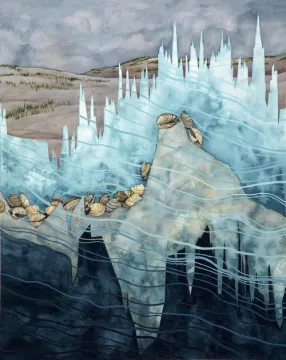
- Jill Pelto beautifully combines data and artistic representation in this watercolor that details some of the data from Quahog clam shells found on the seafloor of the Gulf of Maine.
- It incorporates isotope data over long periods of time that have been captured in the shells of the long-lived clams.
Teaching Materials
Positives
- This watercolor gorgeously depicts how gathering data from Quahog clam shells at the bottom of the Gulf of Maine can teach us about the ocean's past.
- Jill Pelto demonstrates how to use data and art together to make a point that is more clear to a broader range of students.
Additional Prerequisites
- Students should be comfortable reading line graphs.
- Students should know what isotopes are and how they can be used for studying climate conditions in the past.
Differentiation
- This piece would work equally well in an art class or a science class.
- Cross-curricular connections can be made in social studies classes learning about populations and how they learn from the past.
- Science classes could use this art piece as a hook for lessons about changes to populations and habitats or for lessons about isotopes, paleoclimatology, and mollusks.
- Students could use this piece of art as inspiration for their own art. Have them find or create a graph that details something else they are interested in and overlay it with art that details the graph's subject.
- As an extension, create a gallery of the artwork generated and invite other classes to visit!
This watercolor by Jill Pelto depicts changing oxygen, radiocarbon, and nitrogen isotope ratios in Quahog clam shells in the Gulf of Maine from 1680-2000. This piece is an artistic representation of Fig. 4.3 (page 120) in Whitney (2020). A quick read of Chapter 4 in that dissertation will be necessary to make much sense of the painting. The dissertation clearly illustrates how these isotope ratios trend with changing water temperature and salinity in a roughly 100 year pattern, but the piece is of only artistic value without a wealth of prior knowledge. This resource is recommended for teaching for advanced students. Whitney, N.M. (2020). Using Modern and Paleoceanographic Isotopic Systems to Reconstruct Late Holocene Temporal Oceanographic Variability in the Rapidly Warming Gulf of Maine. (Publication ID 27835391) [Doctoral dissertation, Iowa State University, Ames].
Teaching Tips
Standards
Resource Type and Format
Scientist Reviewed
This resource has been reviewed by SubjectToClimate's climate scientists and verified for scientific accuracy and up-to-date information. Our review process ensures that every resource in our library reflects the current state of climate science.
Learn about our review process →