
What Do Warmer Waters Mean for Life Below the Waves?
Provided by: The Climate Question|Published on: September 23, 2022|Last updated: July 16, 2026
Grades: 6, 7, 8, 9, 10, 11, 12
Type: Podcasts
Subjects: Biology, Earth and Space Sciences, Geography
Authors: The Climate Question
Location: Asia, Earth, Oceania
This resource has been reviewed by SubjectToClimate's climate scientists and verified for scientific accuracy and up-to-date information. Learn about our review process →
This resource has been reviewed by SubjectToClimate's climate scientists and verified for scientific accuracy and up-to-date information. Learn about our review process →
Synopsis
- In this podcast, students will learn that the oceans have mitigated the effects of climate change by absorbing extra heat and carbon from the atmosphere, but that this has taken a toll on marine ecosystems.
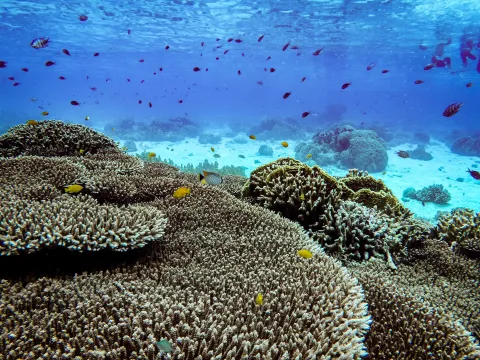
- Some of the negative impacts discussed include dead zones, species migrations towards the poles, and coral reef bleaching.
Teaching Materials
Positives
- The hosts speak with many experts in the field of ocean research and conservation.
- The podcast ends on a hopeful note, reminding us that if we act now, it is not too late to prevent some of the worst outcomes for our oceans.
Additional Prerequisites
- The ocean-related content ends at 22 minutes, 52 seconds and the remaining segment is about two recent news stories related to climate change.
- It ends with an ad for another BBC podcast.
Differentiation
- If students live in a community near the coast, they can research how their local ocean ecosystems are impacted by climate change and if there are any conservation efforts underway.
- Cross-curricular connections can be made with economics classes by focusing on the impact of warming oceans on the fishing industry or the communities that rely on fishing and eco-tourism.
- Civics classes can explore the role of governments and international agreements in protecting the vast areas of open ocean.
- Additionally, connections can be made with chemistry classes by investigating ocean acidification, why oceans absorb carbon and heat, and why warmer water holds less oxygen.
- Other related resources include this video about ocean acidification, NASA data about rising ocean temperatures, this lesson plan about coral reefs, and this article about ocean migration.
This podcast highlights the impact of ocean acidification on marine ecosystems, including corals and other aquatic species. The ocean absorbs nearly 93% of heat and a large proportion of atmospheric CO2. On that account, the ocean becomes warmer and acidic, creating a dead zone in some parts. This is already causing coral bleaching, threatening life below water and impacting fishing livelihoods. This resource has no misconception in data and is recommended for teaching.
Teaching Tips
Standards
Resource Type and Format
Scientist Reviewed
This resource has been reviewed by SubjectToClimate's climate scientists and verified for scientific accuracy and up-to-date information. Our review process ensures that every resource in our library reflects the current state of climate science.
Learn about our review process →