Vampires, Werewolves Rejoice: The Blood Moon Eclipse is Nigh
March 2, 2026

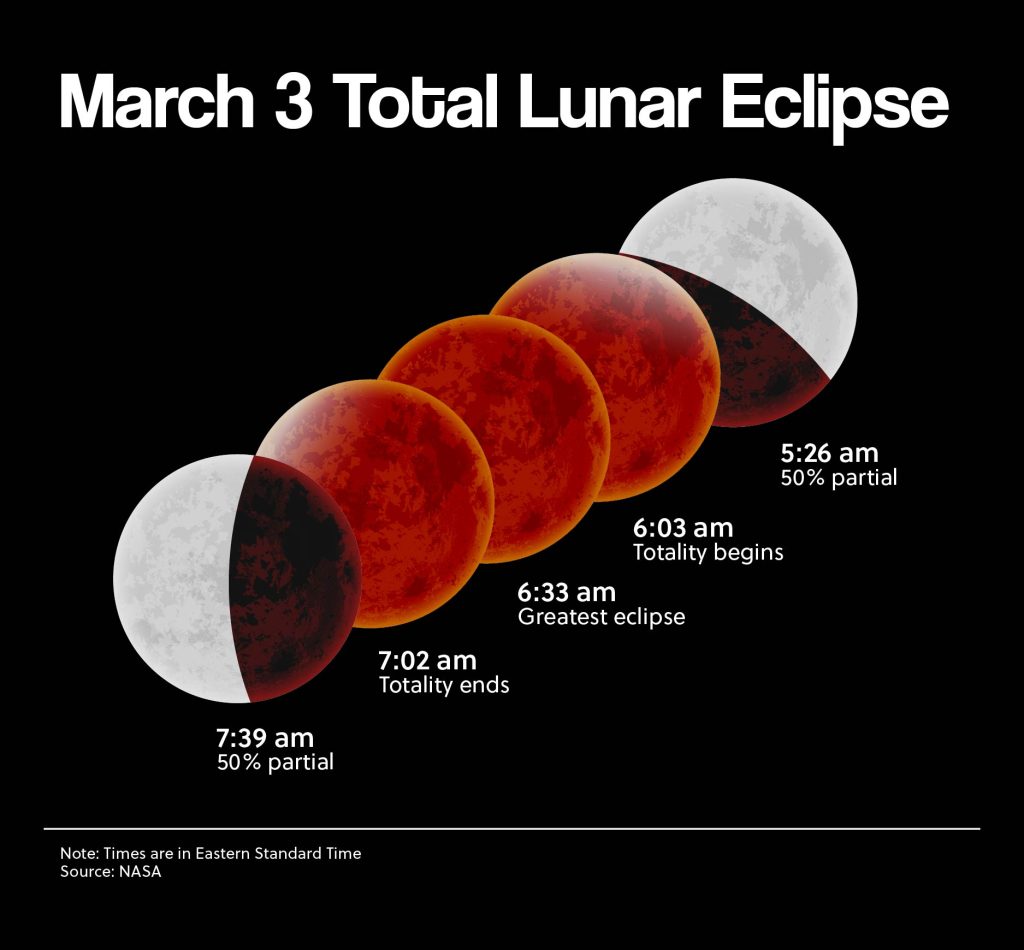
Early Tuesday morning, North America will see a “total blood moon eclipse.” It might seem like something out of a monster movie. But the celestial event is actually a natural phase of the moon’s movement around Earth, rather than the result of a centuries-old curse or villain’s evil plan.
The lunar eclipse will be visible across North America. It begins at 4:49am Eastern. Over the course of several hours, the moon will gradually take on a deep, reddish hue. The totality, or the point at which the eclipse is at its fullest, will begin at 6:03am Eastern. It will last for about an hour. West Coast watchers will be able to see the moon look completely red. East Coast skygazers may have the rising sun to contend with as they try to glimpse Earth’s “bloodied” satellite.
The science behind the blood moon has to do with Earth’s position vis-a-vis the moon and sun. When Earth casts its shadow, also known as its umbra, on the moon, it blocks the sun’s rays. That darkens the moon’s face. A complete blockage of light results in an eclipse. If some light does manage to get past but is still filtered by Earth’s proximity (a “penumbra”), it can cast a dimmer, reddish shadow—the “blood” part of tonight’s moon.
Earth is quite far from the moon at this point in its rotation. It isn’t able to block all the sun’s rays. Some will filter through Earth’s atmosphere. Lower frequencies (think the “Blue-Indigo-Violet” part of the rainbow’s ROY G BIV spectrum) will get absorbed. That leaves only the higher frequency red light to trickle onto the moon’s surface.
Astronomers say tonight’s event is rare. The next lunar eclipse visible from North America won’t be until June 25, 2029.
Reflect: If you could watch a rare event in the sky that only happens every few years, who would you want to experience it with, and what would make that moment unforgettable for you?
News brought to you by 
Read More News Stories Today!