Antarctic Shark Pic Pokes Stick at Scientific Axiomatic
March 3, 2026

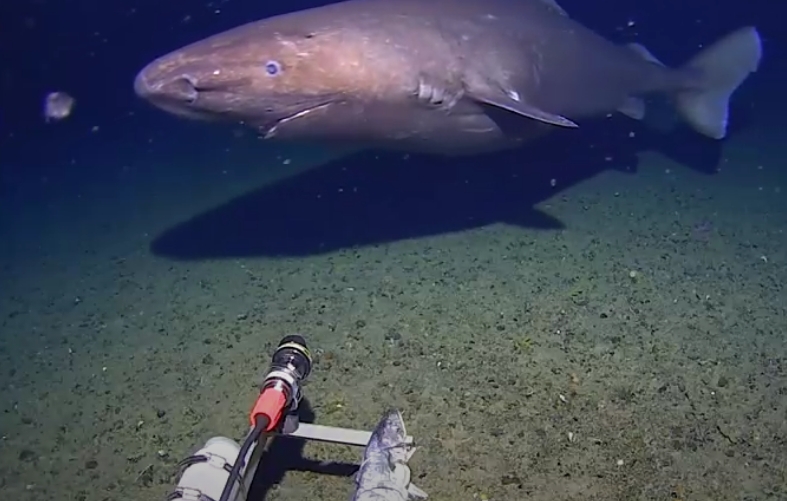
As any marine biologist might tell you, the sea is full of surprises. Still, plenty of axioms have guided scientific thinking about ocean life. Among them: There are no sharks in the Antarctic Ocean.
Leave it to one of the predators to take a bite out of that notion.
"We went down there not expecting to see sharks because there's a general rule of thumb that you don't get sharks in Antarctica," researcher Alan Jamieson told The Associated Press (AP).
Jamieson works at the Minderoo-UWA Deep-Sea Research Centre. He recently reviewed deep-sea camera footage taken in 2025 off the coast of the South Shetland Islands in the Antarctic Sea. He was shocked to see the barrel-like muzzle of a sleeper shark caught on camera. "And it's not even a little one either,” Jamieson recalled. “It's a hunk of a shark. These things are tanks.”
The sleeper shark is estimated to be between 10 and 13 feet long. It was seen at a depth of 1,608 feet. It had likely noticed the bait attached to the camera. The bait was meant to attract skates, sea stars, and other creatures.
Other biologists praised Jamieson’s “significant” find. They suggested that the sighting of the shark could inspire more Antarctic marine research. Some believe that the shark could’ve been driven so far south by climate change. But Jamieson cautioned that sleeper sharks may have been there all along. Most Antarctic studies take place in the (human-friendly) warmer summer months.
“The other 75% of the year, no one’s looking at all. And so this is why, I think, we occasionally come across these surprises,” Jamieson told the AP.
Reflect: How do you usually respond when something challenges what you thought you already knew?
Picture of sleeper shark in Antarctic Ocean courtesy deepseaUWA on Instagram.
News brought to you by 
Read More News Stories Today!