Pacific Salmon: Reading and Writing Lesson
Lesson Plan
1 hour 40 minutesGrades3, 4, 5English Language Arts, Visual and Performing Arts
This resource has been reviewed by SubjectToClimate's climate scientists and verified for scientific accuracy and up-to-date information. Learn about our review process →
Written by Tana Shepard
About this lesson
In this lesson, students learn the threats that salmon face, collaborate in oral storytelling, and share their perspectives with local stakeholders.
Step 1 - Inquire: Students discuss the salmon life cycle, salmon habitat needs, and threats salmon face due to climate change or human impacts and connect to their lived experience with oral storytelling.
Step 2 - Investigate: Students use their senses and go on an imaginative field trip to incorporate details into their salmon stories.
Step 3 - Inspire: Students use a group storytelling technique called Story Spine to tell their own salmon and climate stories and share them with local stakeholders.
Preview the lesson plan
Better on a bigger screen? Open it in its own tab.View Lesson Plan
Everything you need to teach it
How to edit these materials (video)Teaching tips
Positives
- This lesson can be taught after or during a salmon or fish unit.
- This lesson provides opportunities for social-emotional check-ins so that students can recognize and understand their feelings as they learn about salmon and human-caused and climate-related problems.
- Students have multiple opportunities to work effectively with partners or small groups.
- Students feel empowered as they learn how to protect salmon and waterways and educate others about the importance of habitat protection and climate action.
- Students have opportunities to practice oral speaking skills.
Additional Prerequisites
- Students should be familiar with the salmon life cycle. The following resources can help students who are unfamiliar with the topic:
- This lesson can be connected to the following lessons from the Oregon Department of Education:
- Teacher will need to gather the following items:
- Copies of Student Documents (document can also be shared digitally)
- Salmon resources or stories used in the unit of study
- Copies of Story Spine cards (optional)
- Recording tools
- Chart paper or whiteboard space
Differentiation
- Students can work on their stream story in mixed-ability groups, pairs, or individually.
- The oral response activity in the Inspire section can be tailored to suit students’ needs. For example, stronger speakers can be tasked with including three or more details in their responses.
- Teachers can change how students share their oral responses or require that students share their responses in more than one way (e.g., watershed council, social media post, newspaper article, etc.).
- Extension opportunities include having students tell their stories to younger student buddies, write their stories down, or draw pictures to go with the stories.
- Stories could be turned into a story album to be shared as a collection.
- Teachers can sign up for a free educator account on VoiceThread, a storytelling tool for the classroom.
From the scientist review
The relationship between people, salmon, and climate change is examined in this lesson. Students are given the opportunity to learn about salmon, their life cycle, the effects of climate change on salmon, and how humans have contributed to salmon overfishing. Additionally, the lesson teaches students basic storytelling strategies so they may write and share their own narratives about how they feel about the catastrophic effects of climate change on salmon populations and how to safeguard salmon species in their ecosystems. After thoroughly fact-checking all the information, this lesson passed our review in terms of science.
Want this to fit your class?
Add your location for local examples, questions, and action ideas.
About the teacher writer
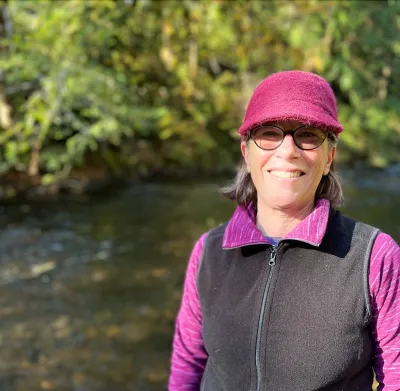
Tana Shepard
Tana Shepard is a K–12 Climate, Energy, and Conservation Teacher with 24 years of teaching experience. She holds a Bachelor of Education and Master of Education from Pacific University. Tana coordinates the 4J/EWEB Education Partnership Program in Eugene, Oregon, and is a founding member of Oregon Educators for Climate Education (OECE). She has extensive experience leading climate education, environmental stewardship, outdoor learning, renewable energy, and conservation initiatives, helping students and educators build the knowledge and skills needed to create a more sustainable future.