Got Trees? Geometry and Trigonometry Lesson
Provided by: MIT Climate Action Through Education|Published on: January 18, 2025|Last updated: July 16, 2026
Grades: 9, 10, 11, 12
Type: Lesson Plans
Subjects: Earth and Space Sciences, Mathematics
Authors: Amy Block
Location: Earth

This resource has been reviewed by SubjectToClimate's climate scientists and verified for scientific accuracy and up-to-date information. Learn about our review process →
This resource has been reviewed by SubjectToClimate's climate scientists and verified for scientific accuracy and up-to-date information. Learn about our review process →
Synopsis
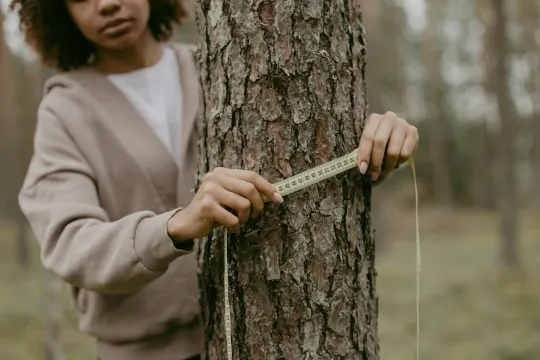
- In this lesson, students will measure trees in their community to determine how much carbon they sequester.
- Students will use various tools and calculators to understand how tree type, circumference, density, and age contribute to the tree's ability to sequester carbon.
Teaching Materials
Positives
- Students will love getting outdoors and will develop a deeper relationship with the trees in their community.
- Learning about this important nature-based solution will help students see how impactful nature can be.
Prerequisites
- Students should be familiar with measuring circumferences and angles and should understand basic trigonometry principles.
- Students will need devices to measure the trees. They will also need to download the GLOBE Observer app before going out to measure.
Differentiation & Implementation
- If there are no trees or few trees near the school, and commuting to an area with trees is not an option, teachers can prepare tree cards with local trees, their address, distance from a building, species, height, and circumference. Students can use these cards to enter the information to find tree density and sequestration ability.
- The online Tree Identifier can help students determine what trees they are measuring out in their community.
- To learn more about how scientists determine the carbon sequestration of trees from afar, students may enjoy the article and video, Why Does This Scientist Shoot Lasers at Trees?. This can help them get a better picture of similar methods to those described in the article.
- To make creative connections, students can make data art or write poetry to demonstrate and celebrate the sequestering power of the tree they measured.
This resource presents the basic science of carbon sequestration through an engaging geometry project. Clear directions and numerous linked sources guide students in understanding how to couple field measurements with trigonometry to calculate the carbon sequestration of a schoolyard tree. This resource skillfully integrates climate science into mathematics and is recommended for teaching.
Teaching Tips
Standards
Resource Type and Format
Scientist Reviewed
This resource has been reviewed by SubjectToClimate's climate scientists and verified for scientific accuracy and up-to-date information. Our review process ensures that every resource in our library reflects the current state of climate science.
Learn about our review process →